
Texas LLC Formation
Safeguard your assets with an LLC- Protect your personal assets from business debts & liabilities
- Protect LLC assets from your personal liabilities
- Expedited (same day) filing
- $400 Flat Fee (+ the state filing fee)
Texas LLC Benefits
Limited liability is not unique to the LLC, but it is one of the main reasons our clients decide to form an LLC. A Texas LLC establishes a firewall between the LLC’s liabilities and the owner’s assets. If, for example, the LLC signs and then breaches a contract, the LLC can be sued. The owners, however, will not be personally liable for the LLC's obligations. Any judgment against the LLC cannot be used against the LLC’s owners or their assets.
In addition to liability protection for the owners, an LLC (unlike other entities) protects the LLC’s assets from the owners' liabilities (see "Protection of LLC Assets" below).
An LLC not only protects its owners from the liabilities of the business but also protects the business (and the LLC's assets) from the personal liabilities of the LLC’s owners.
Unlike a corporation, the LLC protects the LLC’s assets from the owners’ liabilities too! For instance, suppose you own 50% of ABC, LLC. Suppose you are personally sued for a personal obligation (i.e., a car wreck or contract you signed personally), and this creditor obtains a significant judgment against you that you cannot afford to pay. In that case, the creditor can seize your assets. In Texas, your creditor cannot take your ownership interest in ABC, LLC. As such, the assets owned by the LLC are insulated from the owners’ liabilities.
The only mechanism the creditor could use against your LLC interest is a "charging order." A charging order directs the LLC to pay the creditor any distributions of income or profit that would otherwise be distributed to the LLC member/debtor. Since the creditor cannot control the LLC, the creditor only gets a distribution if the LLC decides to make a distribution. If you control the LLC, you can decline to make distributions, and the creditor would receive nothing.
Deductions: An unincorporated business could be missing out on valuable tax breaks.
Reduced Self-Employment Taxes: An S-Corp LLC can reduce the SE tax burden by paying a salary to the owner of the LLC.
You can read more about S-Corp LLCs in our LLC Taxation article.
Larger Contribution Limits: Your LLC allows you to set up retirement funds and life insurance policies with greater contribution limits to set aside money for your future and your family.
Disclaimer: We are not CPAs nor tax professionals, and nothing in this article or site should be considered tax or legal advice. Every LLC’s tax situation is different, and tax situations change over time as a company grows and becomes more profitable. Be sure to discuss with a tax professional before you make any decisions on the structure of your new LLC or change the structure of your existing LLC.
LLCs do not have their own federal income tax classification. As such, the LLC gets to choose between the existing tax classifications. This is an understated benefit of an LLC. The LLC’s tax classification options are:
- Sole Proprietorship/Partnership;
- S-Corporation; or
- C-corporation.
By default (i.e., unless you file a tax election with the IRS), a single-member LLC will be taxed like a Sole Proprietorship, and a multi-member LLC will be taxed like a Partnership, both of which are considered “pass-through” structures, which means the owners, not the LLC, will have the income tax burden.
You can read more in our LLC Taxation article.
Disclaimer: We are not CPAs nor tax professionals, and nothing in this article or site should be considered tax or legal advice. Every LLC’s tax situation is different, and tax situations change over time as a company grows and becomes more profitable. Be sure to discuss with a tax professional before you make any decisions on the structure of your new LLC or change the structure of your existing LLC.
LLCs have few ownership restrictions; one or more owners can own them, and the owners can be individuals, foreigners, trusts, corporations, partnerships, or other business entities. Single-member LLCs are very common, but there are no restrictions regarding the maximum number of members.
Additionally, unlike corporations, there are few restrictions regarding formal management structures; the LLCs are allowed to be managed in whichever manner the owners of the LLC deem appropriate. Corporations are subject to mandatory boards of directors and officers, and there are mandates regarding record-keeping and reporting.
The post-formation requirements are minimal. Each year the LLC must file an annual report (aka Texas franchise tax return) with the Texas comptroller by May 15th of each calendar year. Although the annual report is required for all businesses, franchise taxes are not owed unless the business makes more than $1.18MM in revenue in a calendar year. Read more about the annual costs for a Texas LLC.
As with any business, if you are required to collect and pay Texas sales tax, you will need to report sales quarterly or annually.
Texas LLC FAQs
Still have questions? Give us a call at (214) 206-1999 or send us a message.
A limited liability company (LLC) is a business entity with characteristics of a corporation and a partnership. A Texas LLC provides its owners with liability protection similar to that of a corporation while retaining the beneficial tax characteristics of a partnership.
Forming a Texas LLC (rather than a corporation) dispenses with many burdensome formalities and permits a more flexible operational framework.
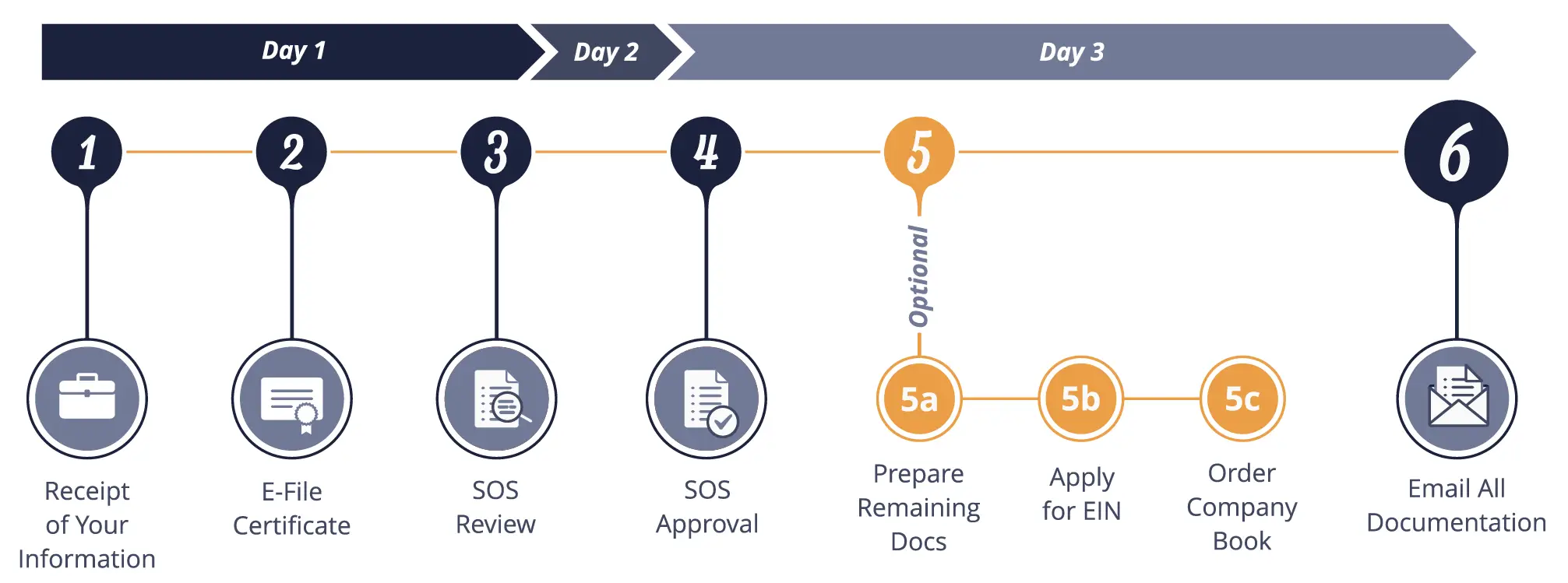
It typically takes us 2 - 4 business days to create a Texas LLC and have everything back to you. See the graphic below for a detailed timeline of the LLC creation process or the full details in our article, "How long does it take to create a Texas LLC?"
An LLC is owned by its members and can be governed by either the members (member-managed LLC) or managers (manager-managed LLC). A manager-managed LLC is very similar in structure to a corporation with a board of directors. A manager-managed structure is often used when there are passive investors, and the investors will be members but not necessarily decision-makers (aka managers).
Member-Managed Example: Four members own an LLC (25% each). When an action requires a simple majority to approve, three of the four members must agree to take action, and if only two members agree, a simple majority would not exist.
Manager-Managed Example: Four members own an LLC (25% each). The four members elect John to serve as the sole manager. As the sole manager, John is responsible for making decisions on behalf of the LLC. The other three members are passive investors with little control over the direction of the LLC. The Company Agreement can dictate when the manager(s) must get the consent of the members. Typically, significant decisions would require the manager(s) to get the consent of the members, whether by a simple majority, super-majority, or even unanimous consent (the level of consent would be dictated by the terms of the Company Agreement).
Traditional LLC. A traditional LLC is the most common type of LLC. Any LLC that is not a special kind of LLC (i.e., Professional LLC or Series LLC) is referred to as a traditional LLC. Likewise, any LLC with only one owner is called a single-member LLC.
Series LLC. A Series LLC is just a traditional LLC with particular language that unlocks the ability to use "series" or cells within the Series LLC. Each (sub) series is insulated from the liabilities of the Master/Series LLC and the other (sub) series. Read more about Texas Series LLCs, or have us create a Texas Series LLC for you.
Professional LLC. A professional LLC ("PLLC") is required only if the business to be conducted by the LLC requires a Texas license. For example, a lawyer must hold a license to practice law, just like a doctor would need a medical license to practice medicine. As such, a law firm or a medical practice would need to be a professional entity like a PLLC. PLLCs can only be owned by licensed professionals (i.e., only licensed doctors can own a medical practice PLLC). To have us create your PLLC, use the entity designation "PLLC" in the order form at the end of the business name. Read more about Texas Professional LLCs.
S-Corp LLC. Any LLC can elect to be taxed as an S-Corp. When ordering your LLC, you'll see an option for S-Corp taxation.
C-Corp LLC. Any LLC can elect to be taxed as a C-Corp. When ordering your LLC, you'll see an option for C-Corp taxation.
If you would like more on S-Corp and C-Corp taxation, you can see our article on LLC Taxation.
Your Texas LLC Lawyer

How To Hire Us
We utilize secure online questionnaires to streamline the hiring process. No office visit required.
- Submit LLC Info to Us. You can use the gold button below to securely submit everything we need to create your new Texas LLC.
- Receive Everything in 3 Days. We will file the formation paperwork with the state and prepare the remaining documents while awaiting approval for your LLC (total turnaround time is typically 3 business).
